
You Didn't Save £50,000. You Bought a £50,000 Dispute
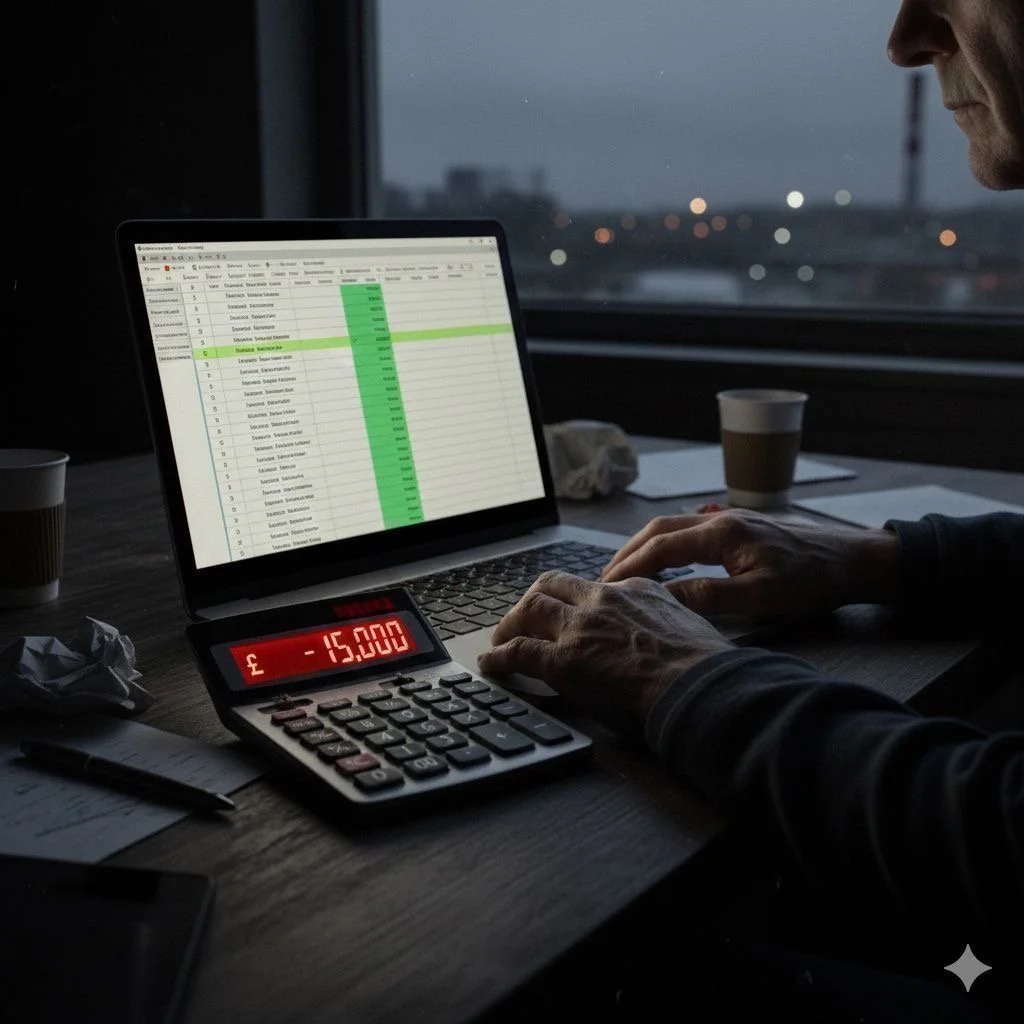
The Green Cells
Every contractor knows the moment. The tender comparison is open on the screen. Six bids line up in descending order, and one of them sits noticeably apart from the rest - price highlighted green, a gap of £50,000 below the nearest competitor.
The Project Manager's finger goes to the number.
"They're £50k cheaper than the next guy. That's pure margin."
He was excited. In his mind, the decision was already made. The spreadsheet had spoken.
I scrolled down to the exclusions. Checked the programme logic. Pulled up the credit rating and the Companies House filing.
"They aren't cheaper," I told him. "They're just desperate."
He ignored me. Appointed them. Three months later, they were in administration. Mid-project. Eight weeks before a critical client milestone. The replacement contractor cost £120,000 more than the original second-placed bid - the one that had looked expensive on the day.
The £50,000 "saving" was not margin. It was a deposit on a disaster.
This is not a story about one project manager making one bad call. It is a story about a procurement culture that has learned to optimise for the wrong number, and the industry is paying for it constantly, at enormous cost, with near-total unawareness of the pattern.
The Suicide Bid Economy
To understand why this keeps happening, you first need to understand what a suicide bid actually is and why contractors submit them.
A suicide bid is a tender price submitted at or below the true cost of delivering the work. The contractor knows, or should know, that the price is not viable. They submit it anyway - for reasons that range from simple estimating error to deliberate commercial strategy.
The deliberate strategy is worth understanding, because it is more common than the industry acknowledges. A contractor with a cash flow problem, a gap in their order book, or a fixed overhead structure they cannot cover without new work is under existential pressure to win the next contract. They look at the job in front of them and make a calculation: if we win this at a loss-making price, we generate cash in the short term, cover our overheads, keep the workforce employed and buy ourselves time to either recover margin through the contract or find better opportunities.
This is not irrational behaviour from their perspective. It is rational short-term survival behaviour with catastrophic long-term consequences for everyone involved - including, most immediately, you.
Because when you appoint a contractor on a suicide bid, you are not acquiring a service at a discount. You are acquiring a set of problems that were created the moment the price was submitted, and will manifest themselves progressively throughout the life of the project.
What You Are Actually Buying
The green cell on the tender comparison represents a number. What it does not represent - and what experienced commercial managers learn to read behind that number - is the programme of events that follows appointment.
You are buying the cash flow crisis. A contractor operating at or below cost has no margin to absorb normal project friction - late deliveries, design changes, weather, labour availability. Every one of those events, which on a healthy project is managed as routine, becomes a cash flow emergency for a desperate contractor. The begging letters start early. Payment applications arrive inflated and early. The arguments about what is and isn't included begin at the first progress meeting.
You are buying compromised quality. Margin is the buffer between adequate performance and excellent performance. A contractor with no margin has no buffer. Every decision about materials, supervision, workforce quality, and programme compliance is made with one eye on cost reduction. The result is not deliberate sabotage - it is the entirely predictable consequence of appointing someone who cannot afford to do the job properly and knows it.
You are buying a confrontational final account. This is perhaps the most underappreciated consequence of the suicide bid. The contractor who prices below cost does not do so naively. They understand, at least at a strategic level, that they need to recover that loss somewhere. The final account is where they intend to recover it. From the first day on site, they are building the claim that will claw back what the tender price surrendered. Every instruction is scrutinised for variation potential. Every event is assessed for extension of time implications. Every communication is read for admission of liability.
The final account dispute you are managing eighteen months later, long after the project is complete and the original team has moved on, was written on the day you appointed them.
You are buying insolvency risk on your critical path. As in the case described above, a contractor operating below cost is financially fragile in a way that a credit check at tender stage may not fully reveal. Their survival depends on a sequence of events - cash receipts, supplier terms, further contract wins - that may not materialise. When the fragility becomes failure, it does so on your programme, at your most exposed moment and at maximum cost to you.
The Incentive Problem Nobody Talks About
There is a structural reason why suicide bids keep winning contracts in construction, and it is not stupidity. It is incentive misalignment.
The person who makes the appointment decision - most commonly a Project Manager or Commercial Manager under pressure from above - is evaluated on the procurement outcome, not the project outcome. Their performance metric is the saving achieved at tender against budget. The green cell on the tender comparison is a win by that measure.
The consequences of that win - the management time, the disputes, the replacement costs, the programme overrun, the client relationship damage - arrive later, are attributed to different causes and are rarely traced back definitively to the original procurement decision. The person who made the call has often moved on to the next project. The incentive system records a procurement success and an operational failure with no connection drawn between them.
Until organisations start measuring the true cost of procurement decisions against project outturn - comparing final account to tender award, not just tender award to budget - this pattern will repeat itself indefinitely. Smart contractors track this correlation. Most don't.
Smart Procurement Versus Lazy Buying
The distinction is straightforward in principle and consistently violated in practice.
Lazy buying looks at one number: the bottom line. The cheapest price wins. The rationale is simple, the spreadsheet is clean and the decision is fast. The outcome is chaos.
Smart procurement looks at a risk profile. The question is not "which price is lowest?" but "which tender represents the lowest risk-adjusted cost of completion?" Those are radically different questions that sometimes produce the same answer and frequently don't.
The cheapest tender price is almost never the lowest final account. The £50,000 saved at appointment frequently costs £150,000 in management time, programme claims, defect rectification and dispute resolution - most of which is invisible in the accounting and none of which is attributed to the procurement decision.
The discipline of smart procurement is the discipline of looking past the headline number to the full picture behind it. That requires both the right analytical framework and the organisational courage to reject a cheap bid when the evidence says it is a risk, even when the short-term pressure is to take the saving.
How to Identify the Suicide Bid Before It Costs You
There is no infallible system. But there are consistent indicators that a tender price is funded by your future stress rather than genuine commercial efficiency, and they are identifiable before appointment.
The Ten Percent Rule
If a bid is more than 10% below the median of the competitive range, treat it as a red flag that requires active interrogation, not a windfall that deserves celebration. The question you must get a credible answer to is: where does this efficiency come from?
There are legitimate reasons for a materially lower price. Owned plant that eliminates hire costs. Local labour that eliminates accommodation and travel. A genuinely innovative method statement. A different interpretation of the risk allocation in the contract.
If they can articulate the specific, quantifiable source of the saving, it may be genuine. If the answer is vague - "we're just hungry for the work" or "we've priced it lean" - that is not an efficiency. It is desperation wearing a commercial vocabulary.
The Exclusion Audit
The bid that looks cheapest on the headline number frequently relies on exclusions, assumptions and qualifications buried in the appendices that systematically strip out difficult or expensive scope. Re-read everything that isn't there, as carefully as you read everything that is.
Reconstruct the bid on a like-for-like basis. Add back the excluded scope at a fair market rate. Resolve the assumptions against your contract requirements. When you've done that exercise rigorously, many "cheap" bids are no longer cheap. The headline number was a function of scope exclusion, not genuine pricing efficiency.
The Financial Health Assessment
A Companies House credit rating is a starting point, not a complete picture. The more revealing indicator is the payment behaviour trend: are they paying their own supply chain on time?
A contractor who is funding operations by extending their supplier payment terms is operating in a state of managed financial distress. They are, in effect, borrowing money from their subcontractors and material suppliers to cover their overhead and cash flow. That arrangement has a finite life. When it breaks - when suppliers stop extending terms, when a key creditor loses patience - it breaks mid-project, at maximum inconvenience and cost to you.
Check the trend, not just the snapshot. Three to six months of payment behaviour tells you far more about the current financial health of a contractor than a static credit score.
The Walk-Away Floor
Set a minimum acceptable price and enforce it. Below-cost appointment is not a bargain - it is a liability. The counterintuitive discipline of rejecting a bid that is too low protects you from a category of risk that no amount of contractual sophistication can fully mitigate once the appointment is made.
This requires organisational will. There will be pressure - from above and from the spreadsheet - to take the cheap price. The commercial manager's job, in those moments, is to hold the line with evidence.
The Full Cost of Getting This Wrong
The project described at the opening of this article illustrates one version of the cost. But the replacement contractor bill is only the most visible line item. It is rarely the largest.
Management time absorbed by a failing contractor is the cost that never appears on a project account but is always the most significant. Senior commercial and operational resource diverted from productive work to crisis management, from winning new business to firefighting an appointment that should never have been made. That cost is real, it is substantial, and it is invisible in the accounting.
Then there is programme cost. A subcontractor failure eight weeks before Practical Completion compresses a programme that had no float to absorb it. The client is affected. Liquidated damages may become live. Relationships built over years of work are tested at precisely the moment they should be delivering repeat business.
And there is the claim cost. The confrontational final account - built from day one, as described above - will not resolve itself. It will consume legal fees, expert fees, management time and emotional energy long after the project is finished and the people involved have moved on. It will settle at a number that, added to the replacement costs and the management time and the programme impact, makes the original £50,000 "saving" look almost comically expensive.
This is the arithmetic of lazy buying. The green cell costs far more than it saves, and the cost arrives at the worst possible time.
The Structural Fix
There is no single intervention that eliminates this risk. But the organisations that manage it best share a common characteristic: they treat procurement quality as a measurable output, not an assumption.
They track final account versus tender award systematically, by subcontractor and by procurement decision-maker. They review failed appointments forensically, asking not just what went wrong operationally but what was missed commercially at the point of appointment. They build the findings back into the procurement process, refining the filters and raising the quality of interrogation for future tenders.
Most importantly, they create an environment in which rejecting a below-cost bid is recognised as a commercial skill, not a missed saving. The Project Manager who waves through the suicide bid and generates a short-term procurement "win" should not be celebrated. The Commercial Manager who identifies the risk, articulates it with evidence and prevents the appointment should be.
That cultural shift is harder than any procedural change. But it is the only thing that breaks the cycle.
Before the Next Tender Comparison Lands on Your Desk
If you recognise the dynamic described in this article - if you can think of a project where the green cell became a disaster, or a subcontractor appointment that cost you far more than the tender saving it generated - the question worth asking now is whether your current procurement process would catch it next time.
Would it flag a bid 12% below the median and require a credible explanation? Would it trace the payment behaviour of the bidder over the last six months? Would it reconstruct the bid on a like-for-like scope basis before allowing the comparison? Would it give your commercial team the authority to reject a below-cost appointment, regardless of the short-term budget pressure?
If the honest answer to any of those questions is no, the next green cell on your tender comparison is already a risk you haven't priced.
Matt Lockett
Director, Norcross Commercial Management Limited
matt.lockett@norcross.uk | 07545 533968
Norcross Commercial Management Limited provides expert commercial consultancy to main contractors and subcontractors across the UK. Project basis, fixed-term or flexible retainer - whatever your business needs, when you need it.